Why the Key to Running a Business in Uncertain Times Starts Inside Your Four Walls
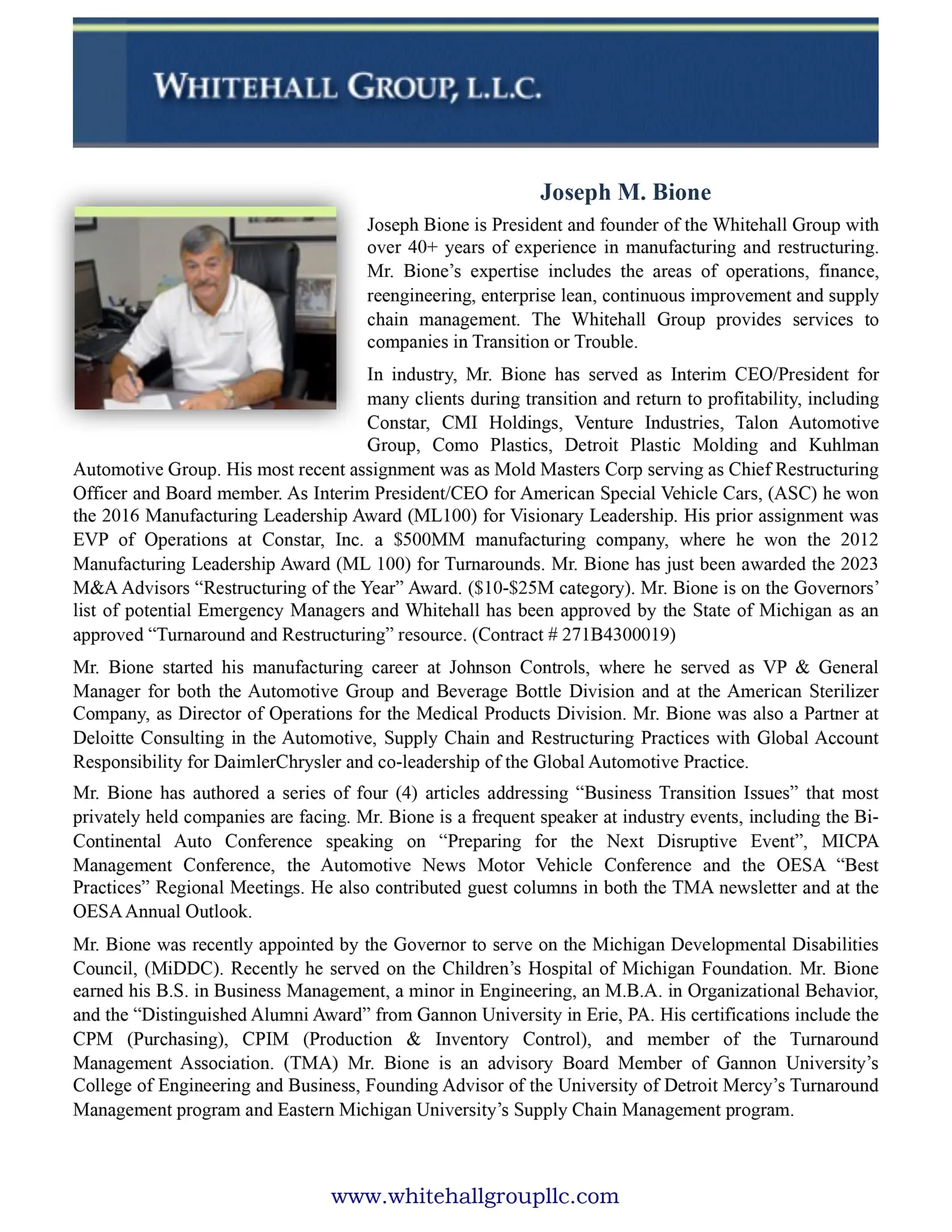
With over 50 years in business and the last 38 years leading Whitehall while running both successful companies and businesses in trouble or transition, there is one question I am asked consistently. This question comes up especially when the marketplace, the economy, the banking world, and global politics all seem to be moving in different directions every day.
The question is simple.
How can I run my business effectively when everything around me is changing so quickly, and the marketplace feels unstable?
I was fortunate early in my career to start at Johnson Controls, which at the time was one of the best-run companies in the country. We were partnered with Toyota in their early years in the United States, long before most people really understood who Toyota was or what they were doing differently.
American manufacturing companies were just beginning to learn lean manufacturing principles. What we practiced went even further than that. Toyota referred to it as Enterprise Wide Lean.
This approach required us to look at every aspect of the business, not just what happened on the factory floor. We examined purchasing, materials management, accounting practices, and how quickly we could close the books to determine whether we actually made money that day. We looked closely at how we hired, trained, managed, and held employees accountable. We evaluated our entire supply chain, our internal processes, and the needs of our end-use customers.
At the same time, we implemented lean manufacturing throughout our plants.
Because we were examining every aspect of the business every day, we were able to stay ahead of many of our competitors. We quickly realized that the best way to deal with uncertainty in the outside world was to have a complete understanding and control of what was happening inside our four walls.
With Enterprise Lean, we operated with clearly defined metrics across the organization. In theory, we could close the books daily. More importantly, we always knew whether we made money that day. And if we did not, we understood why and what needed to be corrected immediately.
The reality is that we cannot control what happens outside our four walls. Markets change. Customers shift. Technology evolves. Global politics and economic pressures constantly create disruption.
What we can control is our own operation.
When you truly understand your capabilities, your strengths, and your weaknesses inside the organization, you gain something extremely valuable. That advantage is agility.
Agility allows a company to move faster than its competitors when something happens outside its four walls. Whether the event is positive, negative, or an unexpected opportunity, an agile organization can respond quickly because it already understands its operational and financial position.
It can evaluate the risk and the reward and act accordingly.
In other words, it becomes proactive instead of reactive.
I have been practicing this concept of Enterprise Lean for more than 50 years and especially over the last 38 years working with both profitable companies and companies experiencing significant trouble or transition.
One of the common patterns I see is that organizations often blame their problems on outside forces. They convince themselves that market conditions, competitors, or economic issues are the primary reason their business is struggling.
While those factors certainly play a role, the reality is that most improvements begin inside the four walls of the business.
As a turnaround professional, I can only fix what is happening inside those walls. To do that effectively, we have to identify and understand every operational and financial issue that affects the performance of the business. That means relying on facts, data, and metrics, not assumptions.
Once we have that level of clarity and control internally, we are then in a much stronger position to deal with the external events that affect the business.
This concept has been the foundation of many successful organizations and has been central to my work helping companies stabilize operations, improve profitability, and navigate difficult transitions.
Agility is the key.
But true agility only exists when leadership is completely on top of what is happening inside the business every single day.
That discipline is ultimately what separates companies that survive disruption from those that struggle to react after the fact.
If you would like to learn more about this concept and how it may apply to your organization, I would be happy to have that conversation.
Give me a call and let’s discuss how Enterprise Lean and operational discipline can help position your company to navigate uncertainty and move forward with confidence.